

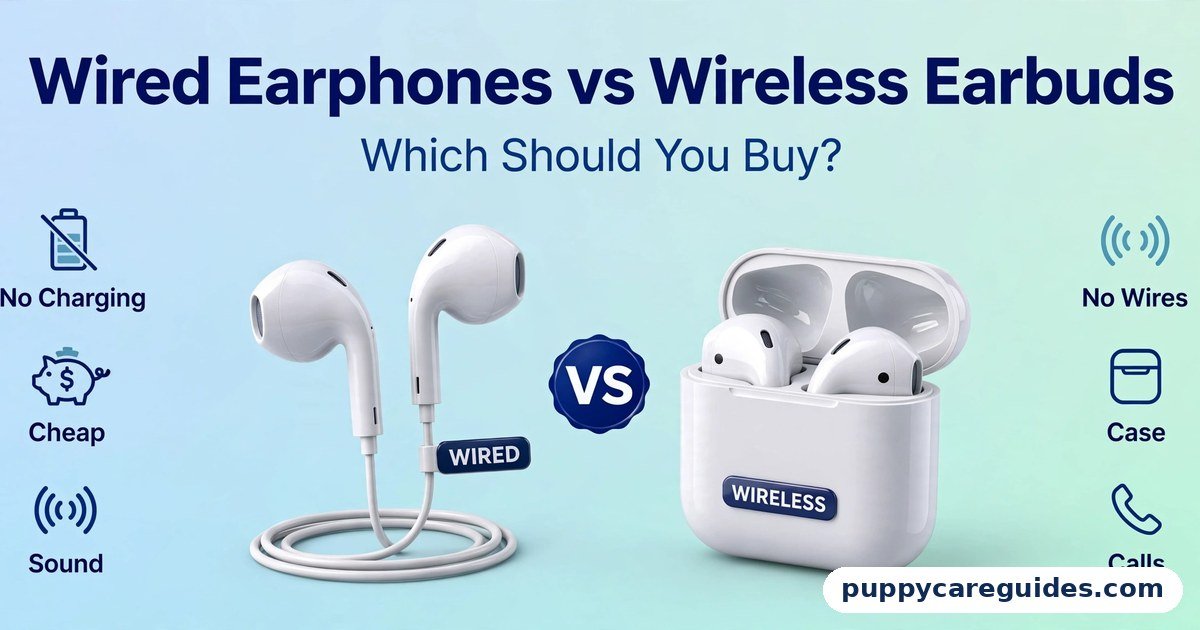
Wired Earphones vs Wireless Earbuds: Which Should You Buy?
Quick Answer
Choose wired earphones for the best sound per rupee/dollar, gaming, and zero battery worries. Choose wireless earbuds for freedom of movement, exercise, travel, and calls on the move. That is the short answer to wired earphones vs wireless earbuds.
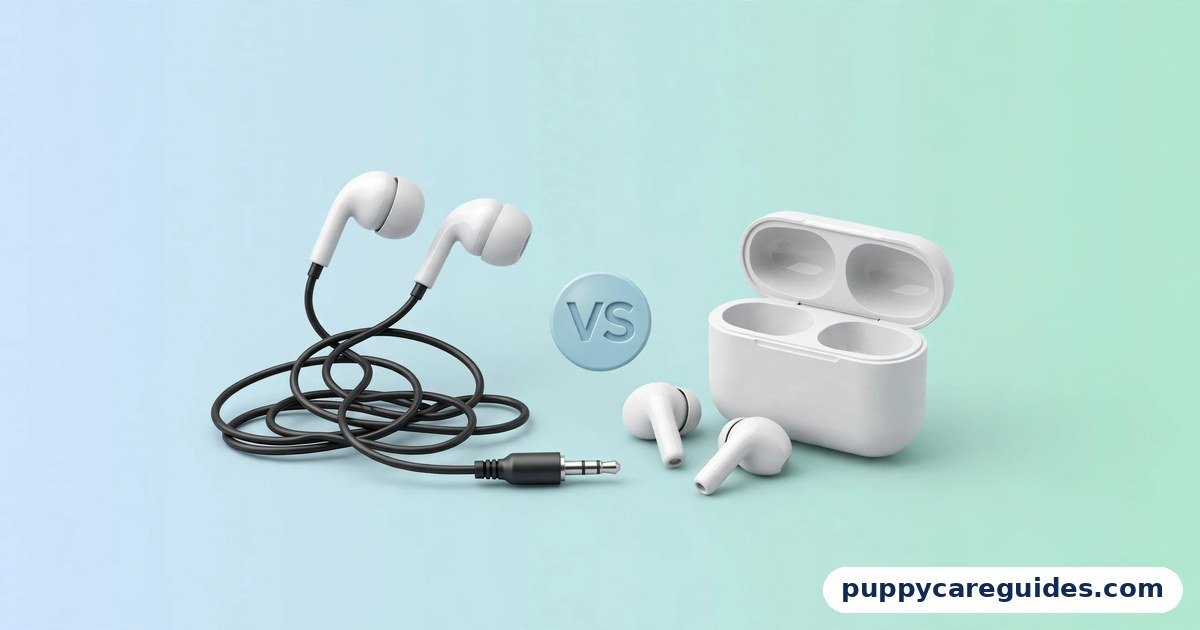
For more technical background, see the headphones overview on Wikipedia.
Table of Contents
At the same price, wired earphones almost always sound better, because every bit of the budget goes into the drivers instead of batteries, radios, and a charging case — and because the audio travels as a clean signal instead of being compressed for Bluetooth. Wireless earbuds win the daily-life contest instead: no cable to snag, nothing to untangle, and they survive commutes, workouts, and video calls with a freedom wired simply cannot match. The catch is responsibility — earbuds must be charged, their batteries wear out within a few years, and losing one small bud is an expensive accident.
Introduction
Few tech arguments are as personal as this one. One camp says wireless earbuds changed their life and they will never go back to a cable. The other camp points out that their cheap wired earphones from five years ago still work perfectly, sound better than buds costing three times more, and have never once needed charging.
Both camps are right — about different things. Wired and wireless are not two versions of the same product; they are two different bargains. Wired trades convenience for sound quality, reliability, and price. Wireless trades a little sound and a lot of simplicity for total freedom of movement. The trick is knowing which bargain matches your actual day, not the day in the advertisements.
This guide compares wired earphones vs wireless earbuds honestly: sound quality at the same budget, the battery truth (including what happens after two or three years), call quality, gaming delay, the lost-bud problem, and what to do if your phone has no headphone jack. For the technology that makes wireless audio possible, see our Bluetooth vs NFC guide — Bluetooth is the half of that pair doing the work here. The wired earphones vs wireless earbuds decision is simpler than it looks once you know what to check first.
wired earphones vs wireless earbuds: Quick Comparison Table
The table below sums up wired earphones vs wireless earbuds at a glance.
| Feature | Wired Earphones | Wireless Earbuds |
|---|---|---|
| Sound quality at same budget | Better — budget goes to drivers, no compression | Good, but part of the price pays for battery, radio, case |
| Audio delay (latency) | Effectively zero | Noticeable on standard Bluetooth; low-latency modes help |
| Battery | None — powered by the phone | ~4–8 hours per charge; case adds several charges |
| Long-term lifespan | Years to decades; cable is the weak point | Battery fades in ~2–3 years and usually cannot be replaced |
| Losing them | Hard to lose — attached to the phone by a cable | One bud lost is a very common, costly accident |
| Call quality | Inline mic near your mouth; clear in noise | Varies widely; cheap buds sound distant, premium buds are good |
| Exercise and movement | Cable snags and pulls | Excellent — nothing to catch, sweat-resistant models common |
| Price | Good sound from very cheap; no extras needed | Decent buds cost more; features climb with price |
| Compatibility | Needs a 3.5mm jack or a USB-C/Lightning adapter | Any phone with Bluetooth |
| Best for | Gaming, editing, careful listeners, tight budgets | Commuting, workouts, calls, travel, tidy desks |
Note: these are same-budget comparisons. Expensive wireless earbuds sound genuinely good — the point is what the same money buys on each side of the cable divide.
What Are Wired Earphones?
Wired earphones are the classic design: two small speakers joined by a cable that plugs into the phone, usually through a 3.5mm headphone jack or, on newer phones, a USB-C or Lightning connection or adapter. The audio signal travels down the wire as electricity, directly from the phone’s audio hardware to the drivers in your ears. The whole wired earphones vs wireless earbuds story starts here.
Because there is nothing else inside them — no battery, no Bluetooth chip, no processor — wired earphones are simple in the best way. They work the instant they are plugged in, they never need charging, they introduce no audio delay, and the signal arrives uncompressed: what the phone sends is what the driver plays.
Good wired earphones (often called IEMs, in-ear monitors, in the hobbyist world) deliver sound quality that embarrasses wireless products at several times the price, and a well-kept pair can serve for a decade. Their weakness is the cable itself: it tangles, it snags on door handles and gym equipment, it conducts rustling noise when it rubs against clothing, and it is the part that eventually breaks — usually at the plug or the earpiece joint.
Real example: A student buys a modest wired pair for the price of a pizza. Five years later, through two phones (with a small adapter for the newer one), they still work every single day, have never been charged, and have never been lost — because they are either in her ears or looped in her bag, attached to nothing and dependent on nothing. In any wired earphones vs wireless earbuds comparison, wired earphones stand for no charging and no lag.
What Are Wireless Earbuds?
Wireless earbuds (often called true wireless) are two independent earpieces with no cable at all — each contains a tiny speaker driver, a Bluetooth radio, a processor, microphones, touch controls, and a small rechargeable battery. They live in a charging case that holds extra power and recharges them between uses, typically giving a total of 20–30 hours of listening before the case itself needs a cable. The wired earphones vs wireless earbuds gap is easiest to understand right here.
Audio reaches them over Bluetooth, which means it is compressed for the journey using codecs such as SBC, AAC, or higher-quality options like LDAC and aptX on supported models. Modern earbuds add features wired cannot offer: active noise cancellation (ANC) that quiets aeroplanes and traffic, transparency mode that lets voices through, wireless charging, water resistance for workouts, and voice assistants on a tap. Battery life is where wired earphones vs wireless earbuds gets practical.
The freedoms are real, and so are the responsibilities. Earbuds must be charged or they are silent. Their tiny batteries age — after roughly two to three years of regular use, most hold noticeably less charge, and they are almost never replaceable, which makes earbuds a product with an expiry date. And each bud is a small, loose object in a world of drains, sofa cushions, and train platforms.
Real example: A commuter taps her case open, the buds connect before they reach her ears, the train’s roar fades under noise cancellation, and a call comes through clearly on her walk from the station — no cable anywhere in the story. At the office she drops them in the case; by the time she needs them again they are charged. This rhythm — freedom in use, charging in the gaps — is the wireless bargain working exactly as designed. In any wired earphones vs wireless earbuds comparison, wireless earbuds stand for freedom from the cable.
wired earphones vs wireless earbuds: Key Differences Between Wired Earphones and Wireless Earbuds
1. Sound quality at the same budget: wired is ahead, and it is not close
This is the most testable claim in the comparison. A wired pair costing a given amount spends nearly all of it on drivers and tuning. A wireless pair at the same price splits the money five ways: drivers, Bluetooth chip, battery, case, and features.
On top of that, Bluetooth compresses the audio — standard SBC and AAC codecs discard some detail before the sound even reaches the bud, while a wire carries the full signal. The result: at equal prices, wired earphones typically offer clearer detail, better bass control, and a wider soundstage. Premium wireless earbuds narrow the gap impressively with better codecs and tuning, and most casual listeners are perfectly happy with them — but they narrow it at a much higher price.
2. Latency: the delay gamers and editors cannot ignore
A wired connection has effectively no delay. Bluetooth audio always has some: commonly 100–300 milliseconds on standard connections, reduced to roughly 40–80 ms on earbuds with dedicated low-latency or gaming modes and modern codecs. For music and podcasts, delay is irrelevant.
For films, phones compensate by delaying the picture to match, so you rarely notice. For gaming — especially fast games where a gunshot or footstep must land the instant it happens — and for video editing, where you are cutting to the frame, the delay is a real defect. Competitive players and editors keep a wired pair for exactly this reason, even if they own good earbuds.
3. Battery: the freedom tax
Wired earphones have no battery because they need none. Wireless earbuds run roughly 4–8 hours per charge depending on model and whether noise cancellation is on, with the case refilling them a few times. In daily commuting that is plenty — but the failure mode is absolute: a dead bud plays nothing, and it will choose a long flight or an important call to prove it.
The longer-term issue matters more. Lithium batteries lose capacity with every charge cycle, and in a device charged daily, two to three years is a typical point where runtime has clearly shrunk. Since the batteries are sealed in, ageing earbuds are usually replaced, not repaired — a running cost wired earphones simply do not have.
4. Losing one: an annoyance vs an invoice
A wired pair is one connected object, usually attached to your phone; losing it is genuinely difficult. A wireless bud is a smooth, thumb-sized object designed to sit loosely in a pocket or case. One slipping out on a train, bouncing off a pavement into a drain, or hiding in bedding is among the most common tech accidents there is.
Manufacturers sell single replacement buds, but at a price that stings — often a third to half the cost of the set — and the replacement must be paired and updated to match its partner. This is not a reason to avoid earbuds, but it is a real line in the budget that wired users never pay.
5. Call quality: the microphone’s distance from your mouth
Here the cheap end surprises people. A wired pair’s microphone sits on the cable, partway to your mouth, and picks up your voice clearly even in street noise. A cheap earbud’s microphones sit in your ears, far from your mouth, and without good processing your voice sounds distant and windy to the person listening — the classic “are you inside a tunnel?” complaint.
Premium earbuds fix this with multiple microphones, beamforming, and wind reduction, and can be excellent. So the rule is budget-dependent: cheap earbuds are usually worse for calls than cheap wired earphones, while good earbuds are better than both, adding noise cancellation for your own hearing too.
6. Movement, exercise, and daily friction
Wireless wins this round without argument. No cable means nothing snags on gym equipment, nothing pulls a bud out when you turn your head, nothing tangles in your pocket into a knot that takes a minute to undo, and sweat-resistant models shrug off workouts and rain.
Wired’s counter-virtues are quieter: nothing to charge before the run, nothing to fall out mid-sprint and vanish, and a cable that doubles as a retrieval string when an earpiece pops out. For desk work, editing, and listening at home, the cable bothers almost nobody; for movement, it bothers almost everybody. Every wired earphones vs wireless earbuds difference above comes back to the cable: freedom versus never charging.
wired earphones vs wireless earbuds: Best Uses of Wired Earphones
- Gaming — zero audio delay for footsteps, shots, and timing-critical play
- Video and audio editing — frame-accurate sound with no Bluetooth lag
- Best sound on a budget — careful listening where every bit of money should buy audio quality
- Long sessions without charging — flights, study marathons, workdays; they simply never die
- A dependable backup — the pair in the drawer that always works when the earbuds are flat or lost
- Calls on a budget — the inline microphone beats cheap earbuds for voice clarity
wired earphones vs wireless earbuds: Best Uses of Wireless Earbuds
- Commuting and travel — noise cancellation against engines and crowds, no cable in the crush
- Exercise and running — sweat resistance and nothing to snag or pull
- Video calls and work calls on the move — walk and talk freely around the house or office
- Everyday phone life — podcasts while cooking, music while cleaning, assistant on a tap
- People who hate cables — the tangle-free pocket experience is a genuine daily pleasure
- Sharing one bud — a single earbud for calls or awareness while the other ear stays open to traffic. For workouts and travel, wired earphones vs wireless earbuds usually ends in the earbuds’ favour.
Pros and Cons
Wired Earphones — Pros
- Better sound for the same money; uncompressed signal
- No battery — never charged, never dies, lasts for years
- Zero audio delay for gaming and editing
- Almost impossible to lose one side; cheap to replace if you do
Wired Earphones — Cons
- Cable tangles, snags, and is usually the part that breaks
- Annoying during exercise and movement
- Many new phones need an adapter because the 3.5mm jack is gone
- No noise cancellation or smart features
Wireless Earbuds — Pros
- Total freedom of movement; nothing to tangle or snag
- Noise cancellation and transparency modes on many models
- Charging case keeps them topped up through the day
- Water resistance, touch controls, and voice assistants built in. That is the wired earphones vs wireless earbuds balance in one line.
Wireless Earbuds — Cons
- Battery fades over ~2–3 years and cannot be replaced — a built-in expiry date
- Dead battery means total silence until charged
- One lost bud is a common and costly accident
- Same money buys less sound quality than wired; cheap models disappoint on calls. This is where the wired earphones vs wireless earbuds choice really bites.
wired earphones vs wireless earbuds: Which Should You Choose?
- Tight budget, sound first: Wired. At low prices the gap in sound quality is at its widest, and you also skip every battery and loss worry.
- Commuter / gym-goer / frequent traveller: Wireless earbuds, ideally with noise cancellation and a sweat rating. Freedom and quiet are what your routine actually needs.
- Gamer or editor: Keep a wired pair as your main tool even if you also own earbuds. Latency is not a preference; for your work it is a defect you can simply opt out of with a cable.
- Heavy call user: Spend properly on earbuds with well-reviewed call quality, or stay wired on a budget — the worst option is cheap earbuds, whose microphones will make you sound far away in every meeting.
- The honest answer for many people: Both. A good wired pair at home for sound and gaming, a decent wireless pair for the world outside. Together they often cost less than one premium earbud set, and each covers the other’s weaknesses. Decide wired earphones vs wireless earbuds by your day — desk and gaming, or moving and training — and the choice makes itself.
wired earphones vs wireless earbuds: Common Mistakes
- Judging earbuds only by music, then living on calls. Reviewers test songs; your boss hears your voice. If calls are half your use, check call-quality reviews specifically, or keep a wired pair for meetings.
- Forgetting the battery’s expiry date when comparing prices. A wired pair at half the price may last three times as long. Cost per year, not cost per purchase, is the fair comparison — and it often flatters wired heavily.
- Buying earbuds with no low-latency mode for gaming. Standard Bluetooth delay makes fast games feel disconnected. If you game, check for a gaming/low-latency mode in the specifications before buying.
- Assuming all wireless sounds bad (or all wired sounds good). Price and tuning matter on both sides. Bad wired earphones are dreadful, and premium earbuds are genuinely impressive. Compare at your actual budget, not by category loyalty.
- Losing buds through pocket-carrying. Buds belong in their case, always — the case is the charger, the tracker anchor, and the only safe pocket they have. Most “lost bud” stories begin with a loose bud in a trouser pocket.
- Giving up on wired because your phone has no jack. A small USB-C or Lightning adapter (or USB-C wired earphones) restores the option for very little money — see the how-to below. The jack’s disappearance is an inconvenience, not a verdict. Most wired earphones vs wireless earbuds regrets come from exactly these avoidable errors.
How to Use Wired Earphones on a Phone Without a Headphone Jack
- Identify your phone’s port: USB-C on most modern Android phones and recent iPhones, Lightning on older iPhones.
- Buy the matching adapter (USB-C-to-3.5mm or Lightning-to-3.5mm) — prefer the phone maker’s own or a well-reviewed one, because the adapter contains a tiny DAC (digital-to-analogue converter) and cheap ones hiss or play quietly.
- Alternatively, buy wired earphones with the USB-C connector built in — no adapter to lose.
- Plug in and test both music and a call: check the inline microphone and buttons work, since button compatibility varies between ecosystems.
- Keep the adapter attached to your earphones’ cable permanently, so the pair is always ready as one unit.
- Note the one trade-off: while wired earphones occupy the port, you cannot charge through it at the same time without a dual adapter — plan around long journeys accordingly. Whichever side of wired earphones vs wireless earbuds you pick, test the fit in your own ears before you commit.
wired earphones vs wireless earbuds: FAQs
How many years do wireless earbuds actually last?
Typically two to three years of regular use before battery life drops noticeably — the tiny cells are charged almost daily, and lithium batteries fade with cycles. After that they still work, just for shorter stretches, and since the batteries are sealed in, replacement usually means a new set. The case battery ages too. Wired earphones have no equivalent clock ticking: their lifespan is set by cable wear, which careful handling stretches to many years. This is the core of the wired earphones vs wireless earbuds debate.
Why do cheap wireless earbuds sound so bad on calls?
Because their microphones are in your ears, far from your mouth, and cheap models lack the multi-microphone processing that isolates your voice from wind and street noise. Your music sounds acceptable because that only needs the drivers; your voice sounds distant because physics and budget are both against it. A wired pair’s microphone hangs near your chin, which is why even inexpensive wired earphones usually win on calls. That is wired earphones vs wireless earbuds in practice.
My phone has no 3.5mm jack — is wired still an option?
Yes, easily. A USB-C or Lightning adapter (depending on your phone) restores the jack for a small cost, and many wired earphones now come with a USB-C plug directly. The adapter contains the little chip that converts digital audio to analogue; buy a decent one to avoid hiss. The only real loss is charging while listening, which needs a dual-port adapter. Our USB-C vs Lightning guide explains the port split if you are between phone ecosystems. That is the wired earphones vs wireless earbuds difference where it counts.
Do wireless earbuds sound worse than wired at the same price?
Generally, yes — and for structural reasons, not snobbery. The earbud’s price must cover batteries, radios, processors, and a charging case before a single sound is made, and Bluetooth compresses the audio on its way. The wired pair spends its whole budget on sound and delivers the signal intact. Premium earbuds with high-quality codecs close much of the gap, but they close it at premium prices. At any fixed budget, wired is the sound-quality buy. That is wired earphones vs wireless earbuds in daily use.
Can I use just one earbud at a time? And can I replace a single lost bud?
One at a time: yes — almost all earbuds work singly for calls and listening, which also doubles your total listening time across the day. Replacing a lost bud: yes, manufacturers sell individual buds, but expect to pay a significant fraction of the full set’s price, and the new bud must be paired and updated to match the surviving one and the case. It is worth doing for premium earbuds; for cheap ones, a new set is often barely more expensive. That is the wired earphones vs wireless earbuds difference that matters most.
wired earphones vs wireless earbuds: Final Verdict
Sound and value = wired. Freedom and features = wireless.
Wired earphones are the better engineering bargain: more sound for less money, no battery to die or age, no delay, and a lifespan measured in years of daily use. Wireless earbuds are the better life bargain: they disappear into your routine, kill the noise of a commute, survive the gym, and never once present you with a tangled knot.
Decide by your day, not by fashion — if your listening happens at a desk, a cable costs you nothing and buys you quality; if your listening happens in motion, the cable is the first thing you will curse. And if you can, own both: it is the rare tech argument where the correct answer really is “one of each.” That is the wired earphones vs wireless earbuds choice in short: wired for value and zero lag, wireless for freedom on the move.
Previous in this category: Fingerprint vs Face Unlock: Which Is Safer and Faster? — the other daily decision where the cheap version and the good version share a name.
Related Articles
- Fingerprint vs Face Unlock: Which Is Safer and Faster? — unlocking the phone your earbuds connect to
- Bluetooth vs NFC: Which Does What on Your Phone? — how Bluetooth carries your music, and why it cannot take payments
- 4G vs 5G: Is a 5G Phone Worth It for You? — streaming quality starts with the connection
- USB-C vs Lightning: Which iPhone Cable Is Better? — the adapter question, fully explained
- MP3 vs AAC: Which Is Better for Music? — the file formats behind the music in your ears


Leave a Reply