

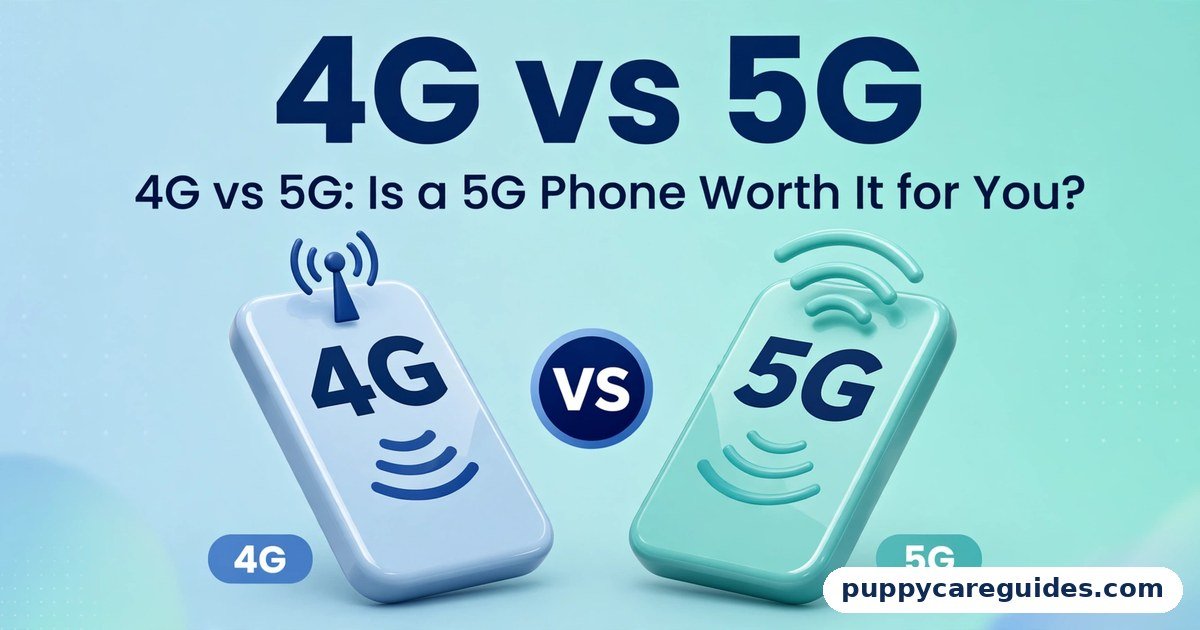
4G vs 5G: Is a 5G Phone Worth It for You?
Quick Answer
Buy a 5G phone if 5G coverage is genuinely good where you live and you plan to keep the phone for three or four years. Stick with 4G if coverage in your area is weak or absent — you would be paying for a network you cannot use. That is the short answer to 4g vs 5g.

For more technical background, see the 5G overview on Wikipedia.
Table of Contents
5G is faster than 4G in the real world — typically several times faster for downloads where coverage is strong — and it responds quicker, which helps calls, gaming, and busy networks. But 5G coverage is uneven: excellent in many city centres, patchy indoors, and missing entirely in plenty of towns and rural areas. 4G, meanwhile, is everywhere, mature, and honestly fast enough for video, social media, maps, and calls. The honest answer is that your postcode matters more than the logo on the box. Check the coverage first; the phone decision makes itself after that.
Introduction
Every phone shop window now shouts about 5G, and every salesperson treats it as the obvious upgrade. Yet plenty of 5G phone owners spend most of their day connected to 4G anyway, and plenty of 4G owners stream video perfectly happily. So what does 5G actually change in daily life — and what is marketing?
The confusion is understandable. Advertised 5G speeds are usually theoretical peaks measured next to a tower, not the averages you will see on your sofa. And “5G” itself is not one thing: it runs on different radio bands with wildly different speed and range, which is why one person’s 5G flies and another’s feels identical to 4G.
This guide compares 4G vs 5G honestly: the real average speeds you can expect, the underrated benefit of lower latency, the coverage reality you should check before spending, and the battery cost nobody mentions. If you are also weighing up SIM choices for a new phone, our SIM vs eSIM guide pairs well with this one. The 4g vs 5g decision is simpler than it looks once you know what to check first.
The table below sums up 4g vs 5g at a glance.
4g vs 5g: Quick Comparison Table
| Feature | 4G (LTE / LTE-Advanced) | 5G |
|---|---|---|
| Typical real-world download | Roughly 20–60 Mbps in many areas | Roughly 100–300 Mbps on good sub-6 GHz coverage; far higher on mmWave |
| Theoretical peak | Up to ~1 Gbps (LTE-Advanced, rarely seen) | Up to 10+ Gbps on paper; mmWave can exceed 1 Gbps in real tests |
| Latency (response time) | Around 30–50 ms typical | Around 10–25 ms typical on good coverage |
| Coverage | Nearly universal in populated areas | Strong in many cities; patchy indoors and in rural areas |
| Building penetration | Good — low bands travel far and pass walls | Sub-6 GHz is decent; mmWave is blocked by walls and even glass |
| Battery use | Lower, mature and efficient | Higher — especially on weak signal or mmWave |
| Phone price | Budget to flagship | Mid-range and up mostly; budget 5G exists but check bands |
| Plan requirement | Any standard plan | Usually needs a 5G-ready plan; most include it now |
| Best for | Everyday use anywhere, tight budgets, weak-coverage areas | Covered cities, big downloads, hotspots, future-proofing |
Note: speed figures are typical ranges reported across many networks and tests, not promises. Your result depends on your carrier, band, location, and how busy the tower is — which is precisely the point of this article.
What Is 4G?
4G is the fourth generation of mobile networks, built on a technology called LTE (Long-Term Evolution), with a faster later version known as LTE-Advanced. It arrived in the early 2010s and replaced 3G so completely that it is easy to forget how big the jump was: 4G turned the phone into a genuine internet device, fast enough for HD video, video calls, and app-heavy life. The whole 4g vs 5g story starts here.
A 4G connection in decent coverage typically delivers a few tens of megabits per second — enough for several HD streams at once — with a response time (latency) around 30–50 milliseconds. The network is mature: towers are everywhere, the technology is well understood, and phones squeeze good battery life out of it because the radios have been refined for over a decade.
4G is not standing still in one important sense: it remains the fallback layer everywhere. Even on a 5G plan, your phone uses 4G for voice calls in many networks and drops back to 4G whenever 5G signal fades. 4G is the floor of modern mobile life, and it is a high floor.
Real example: A family on 4G at home streams a film in HD on the TV through a phone hotspot, a child watches YouTube on a tablet, and two phones scroll social media — all at once, without buffering drama. This is why “is 4G enough?” is a fair question: for the large majority of daily tasks, it demonstrably is. In any 4g vs 5g comparison, 4G stands for wide, reliable coverage almost everywhere.
What Is 5G?
5G is the fifth generation of mobile networks, and its defining feature is flexibility: it can run on low bands that travel far, mid bands (often called sub-6 GHz) that balance speed and coverage, and mmWave bands that deliver enormous speed over very short distances. Most real-world 5G today is the mid-band kind, with mmWave limited to dense spots like stadiums and some city centres in a few countries. The 4g vs 5g gap is easiest to understand right here.
Where mid-band 5G coverage is good, typical downloads run several times faster than 4G — a few hundred megabits per second is common in strong areas — and latency drops noticeably, which makes everything feel snappier and helps real-time uses like gaming and video calls. 5G networks also handle crowds better: a packed stadium or station that would crush 4G can stay usable on 5G because the network has far more capacity. Coverage maps are where 4g vs 5g gets real for most people.
The honest caveats are coverage and consistency. 5G signals — especially the fast kinds — do not travel as far or pass through buildings as willingly as 4G’s lower bands. So the 5G experience is brilliant on one street and absent in the next building. Networks are still being built out, which means the map changes every year in 5G’s favour.
Real example: At a city office with strong 5G, a 2 GB work file downloads in about a minute while the same file on 4G takes several. At a relative’s house two towns away, the same phone shows 4G all weekend because no 5G tower reaches there. Both experiences are “5G phone ownership” — location decides which one you get. In any 4g vs 5g comparison, 5G stands for much faster speeds and lower latency.
4g vs 5g: Key Differences Between 4G and 5G
1. Real speed: a genuine gap, smaller than the posters claim
Ignore theoretical peaks; here is the practical picture. On 4G, expect a few tens of megabits per second in typical conditions — plenty for HD video (which needs roughly 5–10 Mbps), music, maps, and social apps. On good mid-band 5G, expect a few hundred megabits — enough to download films in a minute or two and to run a busy household hotspot. On mmWave, speeds can pass a gigabit, but you must be near the transmitter with clear line of sight.
So yes, 5G is meaningfully faster, but the tasks most people do most of the time were already comfortable on 4G. The difference shows in downloads, uploads, and crowded places — not in opening Instagram.
2. Latency: the improvement you feel but cannot see in speed tests
Latency is the delay between tapping and the network responding. 4G typically answers in 30–50 ms; 5G commonly answers in 10–25 ms, with lower figures as networks mature. You cannot download a file “at latency,” but you feel it everywhere: web pages start loading sooner, video calls feel less like shouting across a canyon, and online games register your actions faster. For competitive mobile gaming and smooth calls, this responsiveness can matter more than raw download speed — and it is the part of 5G that speed-test screenshots never show.
3. Coverage: the check you must do before spending
This is the decisive difference, and it is entirely local. 4G covers effectively everywhere people live in most countries. 5G coverage depends on your carrier’s build-out in your specific streets, and the fast mid-band layer is thinner than the marketing maps suggest (maps often show outdoor coverage; indoor signal is weaker). Before paying extra for 5G, check your carrier’s coverage map for your home, workplace, and commute — and treat “5G available in your city” as meaningless.
If the places you actually spend time show weak or no 5G, a 5G phone gives you an expensive 4G phone. If they show strong coverage, the upgrade is real.
4. Battery: 5G asks for more
5G radios work harder than 4G radios, particularly when hunting for a weak 5G signal, holding a mmWave connection, or running both 4G and 5G layers together (as many networks still do). The result is measurably higher battery drain on 5G in marginal coverage — one reason phones include settings to prefer 4G. In strong 5G coverage the gap shrinks, and newer phones keep improving, but if battery life is your top priority and your local 5G is patchy, forcing 4G is a legitimate, sensible choice rather than a waste of the phone.
5. Price and future-proofing: buying for the next four years
5G no longer means flagship prices — many mid-range phones include it. The smarter way to think is time: networks will keep expanding 5G and slowly shift investment away from 4G, so a phone bought today will live in a more 5G world each year. If you keep phones for three or four years and your area has coverage now or clearly coming, 5G is the sensible default.
If you change phones yearly or your area has no coverage on the horizon, a cheaper 4G phone plus the savings is equally rational. One warning: cheap 5G phones sometimes support only some 5G bands — check that the model supports your carrier’s bands, or you may own a “5G phone” that never finds 5G. Relatedly, make sure your SIM and plan are ready too; see SIM vs eSIM for how the identity side works. Every 4g vs 5g difference above comes back to coverage everywhere versus speed where it exists.
4g vs 5g: Best Uses of 4G
- Everyday life anywhere — messaging, social media, music, maps, and HD video all run comfortably
- Areas with weak or no 5G coverage — the village, the farm, the older building with thick walls
- Budget phones and tight budgets — cheaper handsets and no reason to pay for an unused network
- Maximum battery life — gentler drain, especially where 5G signal is marginal
- Backup and travel phones — simple, universal, works on every network everywhere
4g vs 5g: Best Uses of 5G
- Covered cities and suburbs — where mid-band 5G is strong at home, work, and along your commute
- Big downloads and uploads — large files, game downloads, cloud backups, and creators uploading video
- Hotspot and home-internet replacement — several devices sharing one fast connection
- Crowded places — stadiums, stations, and festivals where 4G capacity collapses
- Gaming and video calls on the move — where lower latency is felt immediately
- Keeping a phone for 3–4 years — coverage will only improve during the phone’s life. For big downloads and busy city use, 4g vs 5g usually ends in 5G’s favour.
Pros and Cons
4G — Pros
- Coverage is essentially everywhere people live and travel
- Fast enough for HD streaming, calls, and all everyday apps
- Kinder to battery life; mature, stable technology
- Cheaper phones and universal plan support
4G — Cons
- Downloads of very large files are slower
- Higher latency than 5G — noticeable in gaming and calls
- Struggles in dense crowds where capacity runs out
- Networks’ future investment is shifting to 5G
5G — Pros
- Several times faster downloads where coverage is good
- Lower latency — snappier browsing, better calls and gaming
- Far more capacity in crowded places
- The network of the next decade; coverage keeps expanding. That is the 4g vs 5g balance in one line.
5G — Cons
- Coverage is uneven; indoors and rural areas often fall back to 4G
- Higher battery drain, especially on weak signal
- The fastest flavour (mmWave) is rare and easily blocked by walls
- Pointless extra cost where your carrier has not built it yet. This is where the 4g vs 5g choice really bites.
4g vs 5g: Which Should You Choose?
- City dweller with confirmed coverage: 5G. You will feel the downloads and the responsiveness daily, and a mid-range 5G phone is now reasonably priced.
- Rural or weak-coverage user: 4G, and spend the savings on storage or battery size instead. Check the coverage map again when you next upgrade.
- Budget buyer: If a 4G phone and a 5G phone are close in price, take the 5G one for future-proofing — but verify it supports your carrier’s 5G bands. If the 5G model costs much more, 4G serves everyday needs perfectly well.
- Gamer / creator / hotspot user: 5G if your main locations are covered. Latency and upload speeds are your working tools, and 5G improves both. Our 1080p vs 4K guide is a useful companion if you are uploading or streaming video over that connection. Decide 4g vs 5g by the coverage where you actually live, and the choice makes itself.
4g vs 5g: Common Mistakes
- Buying 5G without checking the coverage map for your actual addresses. “My city has 5G” can mean three streets downtown. Check home, work, and the commute — two minutes on the carrier’s map saves real money.
- Trusting theoretical peak speeds. “Up to 10 Gbps” describes laboratory conditions on the rarest band. Judge by typical averages for your carrier and area, not the box.
- Assuming a 5G phone is always on 5G. Phones fall back to 4G constantly in patchy areas — watch the status icon move. If it rarely shows 5G, the premium bought you very little.
- Blaming the phone for indoor 5G weakness. High-band signals are blocked by walls, coated glass, and even your hand position. Weak indoor 5G with strong outdoor 5G is physics, not a faulty handset.
- Ignoring band support on cheap or imported phones. A phone missing your carrier’s main 5G band will show 4G forever. Match the model number to your carrier’s band list before buying.
- Paying for a premium 5G plan tier you cannot use. Some carriers sell speed-tiered plans. If coverage at home is 4G-only, the premium tier changes nothing until the towers arrive. Most 4g vs 5g regrets come from exactly these avoidable errors.
How to Check 5G Coverage and Your Phone’s Readiness
- Open your carrier’s official coverage map (website or app) and enter your home postcode, then your workplace. Look specifically at the 5G layer, and whether it claims indoor or only outdoor coverage.
- Ask people on the same carrier in your building or street what their phone actually shows during the day — real reports beat maps.
- Check the phone you want supports your carrier’s 5G bands: find the carrier’s band list (for example, n78 is the common mid-band in many countries; US carriers lean on n41, n71, n258 and others) and match it against the phone’s full specifications for the exact model number.
- Confirm your plan includes 5G. Most modern plans do; some older or very cheap plans need a free upgrade or a replacement SIM — ask the carrier rather than guessing.
- After buying, run speed tests at the places that matter (home sofa, desk, station) at busy times, not just once beside a window. That is your true 5G. Whichever side of 4g vs 5g you are on, check the coverage map for your own area first.
4g vs 5g: FAQs
Do I need a new SIM or a special package for 5G?
Usually not a new SIM: in most networks, an existing 4G SIM works for 5G, and most current plans include 5G at no extra step. There are exceptions — some carriers require a 5G-enabled plan or a newer SIM for their standalone 5G networks — so the safe move is to check your account in the carrier’s app or ask them directly. If they offer a free SIM swap, take it; it removes one variable. (If you are moving to eSIM at the same time, SIM vs eSIM explains how that transfer works.) This is the core of the 4g vs 5g debate.
Will 4G be switched off soon?
No. 4G is the world’s workhorse network and carriers plan to run it for many years alongside 5G — it carries voice calls and the fallback coverage 5G still depends on. It was 3G that was shut down in many countries (the US networks closed 3G in 2022, others followed). A 4G phone bought today will not be orphaned anytime soon, though new investment and the fastest improvements will go to 5G. That is 4g vs 5g in practice.
Why is my 5G speed test barely faster than 4G indoors?
Three usual reasons. First, your phone may be on a low-band 5G layer that trades speed for range and feels much like 4G. Second, walls and modern coated glass weaken the higher bands badly, so indoor signal is often the weakest version of 5G. Third, the icon can say 5G while much of the connection still rides on 4G infrastructure (non-standalone networks). Test outdoors near home and at different times before concluding anything — and compare like with like, same carrier, same spot. That is the 4g vs 5g difference where it counts.
Does 5G drain the battery much faster?
It can, but context decides. In strong coverage with a modern phone, the difference is modest. In weak coverage, the phone strains to hold 5G and drains noticeably faster — sometimes much faster. Many users in patchy areas set their phone to prefer 4G and lose nothing they were actually getting. If your battery dropped right after “upgrading” to 5G, signal quality, not the phone, is the first suspect. That is 4g vs 5g in daily use.
Is a 5G phone worth it if I only use social media, video, and messaging?
Honestly, those tasks run perfectly well on 4G — HD video needs only a fraction of even a modest 4G connection. The case for 5G for you is future-proofing and crowded-place reliability, not daily speed. If a 5G model costs the same or slightly more, take it. If it costs a lot more and your local coverage is thin, a good 4G phone plus the savings is the smarter buy, and you can revisit at your next upgrade when coverage has improved. That is the 4g vs 5g difference that matters most.
4g vs 5g: Final Verdict
Coverage decides: strong 5G where you live = buy 5G. Weak or no coverage = save money with 4G.
5G is a real improvement — faster downloads, quicker responses, more room in crowds — but it is an improvement you can only spend where towers exist. 4G is not obsolete; it is the reliable, universal network that already handles everyday life well and will keep doing so for years. The worst purchase is the uninformed one: a premium 5G phone on an unbuilt network. Spend two minutes on the coverage map, and this decision becomes easy. That is the 4g vs 5g choice in short: 4G for coverage today, 5G for speed where it has arrived.
Next: Fingerprint vs Face Unlock: Which Is Safer and Faster? — the other everyday phone choice where the cheap version and the good version share a name.
Related Articles
- SIM vs eSIM: Which Is Better for Your Phone? — check this before your new phone arrives
- Fingerprint vs Face Unlock: Which Is Safer and Faster? — security you use fifty times a day
- Bluetooth vs NFC: Which Does What on Your Phone? — the wireless pair people always mix up
- JPG vs PNG: Which Is Better for Photos and Logos? — the images you send over that connection, explained
- MP4 vs MKV: Which Is Better for Videos? — what to do with the videos you download at 5G speed

Leave a Reply